


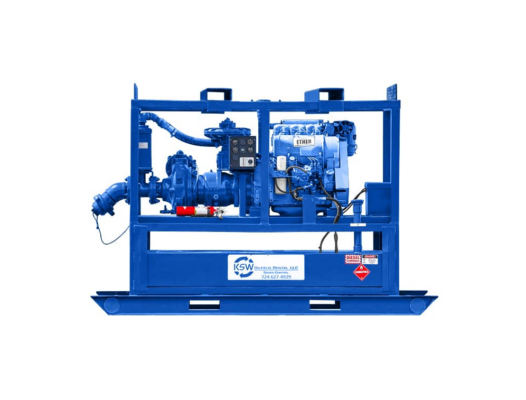
Picking a transfer pump usually comes down to one question that gets asked too late: what exactly is this pump moving, and where’s the power coming from? Diesel and electric pumps aren’t interchangeable, and matching the wrong one to a job can mean a pump that stalls out on heavier fluid, or one that burns fuel unnecessarily when the site already has power available.
This guide walks through when to reach for a diesel transfer pump versus an electric transfer pump, how pump size factors into the decision, and what KSW’s crews actually check before recommending one over the other.
When Diesel Power Is Preferable
Diesel transfer pumps are built for the heavier end of fluid handling. KSW’s diesel pumps are designed for oil-based mud mixing and transfer, handling heavier mud that would strain a smaller electric unit. They run self-contained, with an 80-gallon diesel tank on both the 4″ and 6″ models, which means they don’t depend on the site’s electrical distribution at all.
That self-sufficiency is the main reason to choose diesel: if a location doesn’t have power run to where the pump needs to sit, or if the job involves rolling oil-based mud between tanks in volume, diesel is generally the right call. The 45-degree connections on KSW’s diesel pumps relieve stress on hoses during that kind of repeated tank-to-tank transfer, and forklift slots make it easier to reposition the pump as the job moves around location.
When Electrical Power Is Available and Advantageous
Electric transfer pumps make sense once two things are true: the site has adequate power, and the fluid being moved doesn’t require diesel-level handling. KSW’s electric pumps are built for transferring drilling fluids, moving fluid from tank to pits or sink, and other general site transfer work.
The advantage is largely operational. Electric pumps don’t need fuel monitoring or refueling stops, tend to run quieter, and pair naturally with a junction panel setup if the site is already running other electric equipment off the same power source. For water-based mud and lighter-duty transfer tasks, electric is usually the simpler and more cost-efficient choice, provided the power is there to support it.
1″, 2″, 3″, 4″ and 6″ Pump Considerations
Pump size should be driven by flow volume and line size already in use on location, not picked by default. KSW’s electric pumps come in 1″, 2″, 3″, and 4″ sizes, while diesel pumps are available in 4″ and 6″. As a general pattern:
- 1″ and 2″ electric pumps fit smaller transfer tasks, like moving fluid from a tank to a pit or sink where volume is limited.
- 3″ and 4″ electric pumps step up for higher-volume drilling fluid transfer where a smaller pump would take too many cycles.
- 4″ diesel pumps handle standard oil-based mud mixing and transfer jobs.
- 6″ diesel pumps are the choice for high-volume mud mixing where a 4″ pump would become a bottleneck.
Undersizing a pump doesn’t just slow the job down. It also puts more wear on the pump running at capacity for longer stretches, which is generally worse for uptime than starting with the right size.
Moving and Rolling Oil-Based Mud
“Rolling” mud, that is, circulating it between tanks to maintain consistency, is one of the more demanding tasks a transfer pump handles regularly. KSW’s diesel transfer pumps are built specifically to transfer oil-based mud or fluids and roll oil-based mud in tanks, which is why diesel tends to be the default for this application rather than electric. The heavier viscosity and volume involved in mud rolling generally call for the higher-capacity handling that diesel pumps are built around.
Pumping Between Tanks and Pits
General tank-to-pit or pit-to-tank transfer is where electric pumps often do the job just as well as diesel, at lower operating cost. If the fluid is water-based and the transfer distance and volume are moderate, an electric pump sized appropriately for the line will typically move the job along without needing diesel’s extra capacity. This is also where manifold configuration matters: a properly staged manifold reduces the number of hose changes needed as fluid moves between multiple tanks and pits over the course of a job.
Vac-Assist Pumps for Cellars and Non-Gravity-Fed Areas
Standard transfer pumps rely on gravity or a flooded suction line to prime. Cellars, pits, and other non-gravity-fed areas don’t offer that, which is where vac-assist diesel pumps come in. KSW’s vac-assist pumps, available in 4″ and 6″ sizes, are built specifically for cellars or areas that aren’t gravity fed, with the same 80-gallon diesel tank and 45-degree hose connections as the standard diesel line.
If a job involves pulling fluid out of a cellar or a similarly awkward, non-gravity-fed space, vac-assist is generally the equipment to reach for rather than trying to force a standard transfer pump to prime in a location it wasn’t built for.
Electrical Requirements
Before an electric pump goes out, it’s worth confirming the site can actually support it. That means checking available amperage, whether a junction panel is already staged on location, and how many other electric units, shaker washers, vacs, other pumps, will be drawing from the same source. A junction panel rated for 100, 200, or 400 amps can distribute power to multiple pieces of equipment at once, but only if it’s sized correctly for the total load from the start.
Diesel pumps sidestep this question entirely, which is part of why they remain the default for locations still being set up or for jobs where electrical infrastructure isn’t fully established yet.
Mobility, Hose Configuration and Jobsite Setup
Both pump types are built with forklift slots for lifting and repositioning, but how a pump gets set up still affects how well it performs. The 45-degree hose connections on KSW’s diesel and vac-assist pumps are designed to reduce stress on hoses during repeated repositioning, which matters on jobs where the pump gets moved multiple times as tanks fill and empty. Manifold placement matters too: staging a pump near a properly configured manifold cuts down on the number of individual hose runs needed across location, which reduces both setup time and trip hazards.
Questions KSW Asks Before Recommending a Pump
Before recommending a specific pump, KSW’s team generally works through:
- What fluid is being moved, and is it oil-based or water-based?
- What volume needs to move, and over what timeframe?
- Is the pump location gravity-fed, or does it need vac-assist?
- Is site power available and sufficient, or does the job need to run on diesel?
- What size line is already in use, and does the pump need to match it?
A Quick Reference
| Requirement | Likely Equipment |
| Cellar or non-gravity-fed area | Vac-assist diesel pump |
| High-volume mud mixing | 6″ diesel pump |
| Electric power available on site | Electric transfer pump |
| Smaller fluid-transfer application | 1″ or 2″ electric pump |
| Oil-based mud rolling between tanks | 4″ or 6″ diesel pump |
Request Help Selecting a Transfer Pump
Matching pump type and size to the job isn’t always obvious from a spec sheet, especially once vac-assist, manifold configuration, and site power all factor in. Contact KSW to talk through your fluid handling needs and get a transfer pump matched to your site before the job starts, not after something stalls out.